History of Clan MacDuff

The Royal Lineage of Clan MacDuff
Clan MacDuff (or Clan Duff) occupies a unique and exalted place in Scottish history. Tracing their origins to the royal Scoto-Pictish line, they are one of the oldest and most prestigious families in the kingdom. Their legacy is built on centuries of loyalty, royal privilege, and the leadership of the Earls of Fife. While the clan currently has no Chief, its history remains a testament to the power and endurance of the ancient Gaelic nobility.

I. Who Are Clan MacDuff?
Clan MacDuff is a historic Lowland clan with deep royal connections. Currently classified as an armigerous clan (meaning it has no recognized Chief), the family was once led by the powerful Earls of Fife. This title was the premier earldom in Scotland, carrying immense privileges. Although the original line of Earls failed in the 14th century, the title was revived in 1759 by William Duff and later elevated to a Dukedom in 1889 under Alexander Duff, who married into the British Royal Family.
II. The Origins of the Name
The surname MacDuff (and variants like McDuff, MacDuffie, McGiff) derives from the Gaelic Mac Dubh, meaning "Son of the Black [Man]." This descriptive name likely referred to a dark-haired ancestor rather than skin color, distinguishing the Gaelic Scots from the fair-haired Norse settlers of the time.
While popular culture links the name to Shakespeare’s Macbeth, the historical connection is more symbolic. The name represents a legacy rather than a direct lineage to a specific 11th-century figure named MacDuff. Historical records show the name appearing as early as 1264 with Malisius McDuf, and it has since spread across Scotland and Ireland.
III. Where did Clan MacDuff Originate?
The clan’s roots are royal. They descend from Queen Gruoch (the real Lady Macbeth) and the ancient Scoto-Pictish monarchy. After the fall of Macbeth, the line continued through Aedh, who married Queen Gruoch’s granddaughter. Aedh became the Earl of Fife and Abbot of Abernethy, the ancient Pictish capital.
Sir Iain Moncreiffe, a noted historian, described Clan MacDuff as the premier clan of the Scottish Gaels. The early chiefs, such as Gille Míchéil, Earl of Fife, were powerful enough to witness royal charters for King David I, cementing their status at the heart of the Scottish kingdom.

IV. A History of Power and Resilience
The history of Clan MacDuff is woven into the very fabric of the Scottish nation.
-
14th Century: The clan played a pivotal role in the Wars of Independence. In 1306, Isabella MacDuff defied the English King Edward I to crown Robert the Bruce at Scone, fulfilling her family's hereditary right. For this act of defiance, she was imprisoned in a cage hanging from Berwick Castle.
-
18th Century: The clan’s martial spirit endured. Captain Robert Duff fought for the government during the 1745 Jacobite Rising. In 1759, the title was restored when William Duff was created Earl Fife and Viscount MacDuff.
-
19th Century: The family reached new heights when Alexander Duff, 6th Earl Fife, married Princess Louise, daughter of King Edward VII, and was created Duke of Fife in 1889.
V. The Law of Clan MacDuff
The Law of Clan MacDuff was a unique legal privilege granted by the Scottish Parliament in 1384. It offered sanctuary to any kinsman of the MacDuff chief (within nine degrees of relationship) who committed homicide in hot blood. By reaching the Cross of MacDuff near Abernethy and paying a fine, they could be pardoned.
The clan also held the hereditary honor of Crowning the King of Scots. This right was exercised famously by Isabella MacDuff for Robert the Bruce. Today, the bearer of the Scottish Crown is the Duke of Hamilton, who holds the title Lord Abernethy, a legacy of the MacDuff line.
VI. Clan Symbols: Crest and Coat of Arms
-
Crest: A demi-lion Gules (red) holding a broadsword. This symbolizes the martial strength and royal connection of the clan.
-
Motto: Deus Juvat (God Assists).
-
Coat of Arms: A Red Lion Rampant on a gold shield. This design is strikingly similar to the Royal Banner of Scotland, reflecting the clan's royal descent.
[INSERT IMAGE HERE: Clan MacDuff Crest Badge] 👉 Shop the Exclusive Clan MacDuff Collection
VII. The MacDuff Tartan
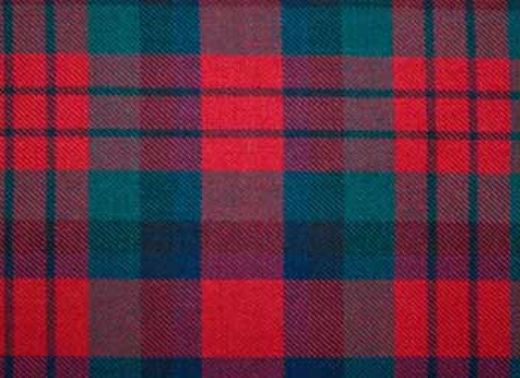
The MacDuff tartan is iconic, closely resembling the Royal Stewart tartan but distinguished by the absence of the white and yellow over-checks. This similarity further underscores the clan's royal status.
-
Variations: There are several recognized patterns, including MacDuff Ancient, MacDuff Hunting (featuring darker greens and browns), and MacDuff Dress (often with white prominence).
-
History: Recorded by weavers like William Wilson & Son in the late 18th century, the tartan remains a popular symbol of Scottish identity today.